
 Part III of Brand Erosion Starts Inside
Fix What’s Breaking Inside Before Clients Notice
From Seeing to Doing
You can feel when work has become harder than it should be. A decision keeps coming back to the founder. People are unsure who owns the next step. The same frustration surfaces in another leadership meeting. The question is not just what is going wrong inside; it is what needs to change so your team can deliver what you promise your clients.
I have sat in leadership meetings where everyone agrees something is off. The founder nods. The COO has examples. Someone says, “We really need to address this.” Then the calendar wins, and three months later the same conversation happens again. Recognizing the strain is not the hard part. Making room to act on it is.
Part I explored how brand erosion starts inside; Part II showed how to spot it. The concern is real, but the next step is often unclear. Three moves can help turn that shared awareness into action.
Move 1: Connect Internal Signals to the Brand Promise
Name the risk before you choose the response.
Internal concerns often enter conversation as culture issues. It helps to ask what they mean for the firm’s promise to clients. When unclear ownership, inconsistent decisions, or workflow friction make that promise harder to deliver, there is a brand issue to address together.
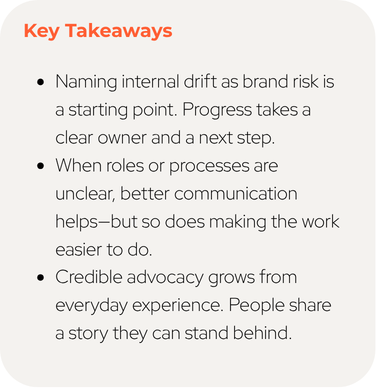
Naming the concern gives the team something specific to work on. The next step is to agree on what needs to change and who will own it.
That connection gives leadership, HR, and the teams doing the work a shared question: what needs to change so people can deliver what we promise?
Try this: Bring one recurring frustration to your next leadership meeting. Ask, “If a client could see this, what would it tell them about us?” Then, “Is it making our promise harder to deliver?”
Move 2: Clarify How Work Gets Done
Clear the fog before you add more communication.
A town hall or clearer update can help. But when ownership is unclear or a process no longer fits the business, communication needs to be paired with changes to how the work gets done.
When ownership is unclear, people spend time figuring out who decides, checking decisions, or working around delays. Clear responsibilities give that time back to work.
In practice, this move comes down to four questions:
- Where is ownership still fuzzy?
- Where are people compensating for weak systems?
- Which decisions take too long or get made twice?
- Where is internal friction affecting the client experience?
Build the answers with the people doing the work. Gallup’s research links involvement in goal setting with clearer expectations—a useful reminder that clarity is something teams build together.
Try this: Choose one decision that keeps getting delayed or made twice. Agree on who owns it, what input they need, and what happens next. Check whether the change makes delivery easier.
Move 3: Create an Experience People Want to Advocate For
Earn advocacy before you ask for it.
Before asking employees to share the firm’s story, it helps to understand whether their experience gives them a story they want to share.
That experience rests on a few everyday essentials:
- Leadership behavior matches the message, especially under pressure.
- Expectations are clear.
- People have the tools and support to do good work.
- Decisions made in hard moments reinforce trust.
A useful question is whether people feel as comfortable recommending the firm as they do expressing pride in it. If not, ask what makes them hesitate.
The response depends on the reason. If people are unsure what to share, offer guidance. If they hesitate because of how the firm operates, focus there first. A content calendar cannot resolve an experience people are reluctant to recommend.
That is the Tuesday test from Part I: does the firm’s promise hold up on an ordinary workday? People advocate for the Tuesday they live, not the all-hands they attend.
Start This Month
Bring one unresolved issue and these five questions to your leadership team:
- What might this cost us over the next six months if nothing changes?
- Where is it affecting execution, trust, or confidence?
- Are expectations clear, and do people have the support to meet them?
- Where does our internal reality still fall short of our external promise?
- What one decision could reduce the strain in the next 30 days?
Notice where answers differ. Those differences can help reveal what still needs to be clarified.
You do not need a massive transformation plan to begin. Choose one change, give it an owner, and agree on what will be different. Review it within 30 days: what has become clearer or easier for the people doing the work?
What This Sounds Like in Practice
Very few firms call us and say, “We have an internal brand problem.” What we hear sounds more like this:
“Growth feels harder than it should.”
“The founder is still in the middle of everything.”
“The team is working hard, but it feels heavier now.”
“Our story sounds strong, but something underneath is not lining up.”
These are starting points for understanding how people, process, and the brand promise are affecting one another.
We know that moment from the inside, too. In our own second year, Revela hit an inflection point and had to tighten our focus, our story, and our operating rhythm (Revela Advisors).
Our work begins there: helping leadership teams identify the underlying strain, agree on what needs to change, and connect the brand promise to everyday decisions and delivery.
One Visible Change
Your people are your first brand. Clear expectations, reliable support, and a better everyday experience give them something real to stand behind. Start with one visible change that helps them deliver the promise you make to clients.
Start with the 10-Question Inflection Point Assessment and bring it to your next leadership meeting.
If you would rather talk the patterns through first, email info@revelaadvisors.com or connect with Alma on LinkedIn.
Related Insights From Revela Advisors
Author
